
Citizens Generic vs Branded Drugs Project
Summary of the MESH Citizens Generic vs Branded Drugs Quality Project
Executive Summary
For years, patients have faced a difficult dilemma: Are expensive “branded” medicines better than cheaper “generic” ones? Many people, including some doctors, worry that lower-cost drugs—especially those from government shops like Jan Aushadhi—might be of lower quality.
To answer this question, a team of researchers conducted the largest citizen-funded study of its kind in India. They bought medicines from regular shops (just like a patient would) and sent them to a top-tier accredited laboratory for rigorous testing.
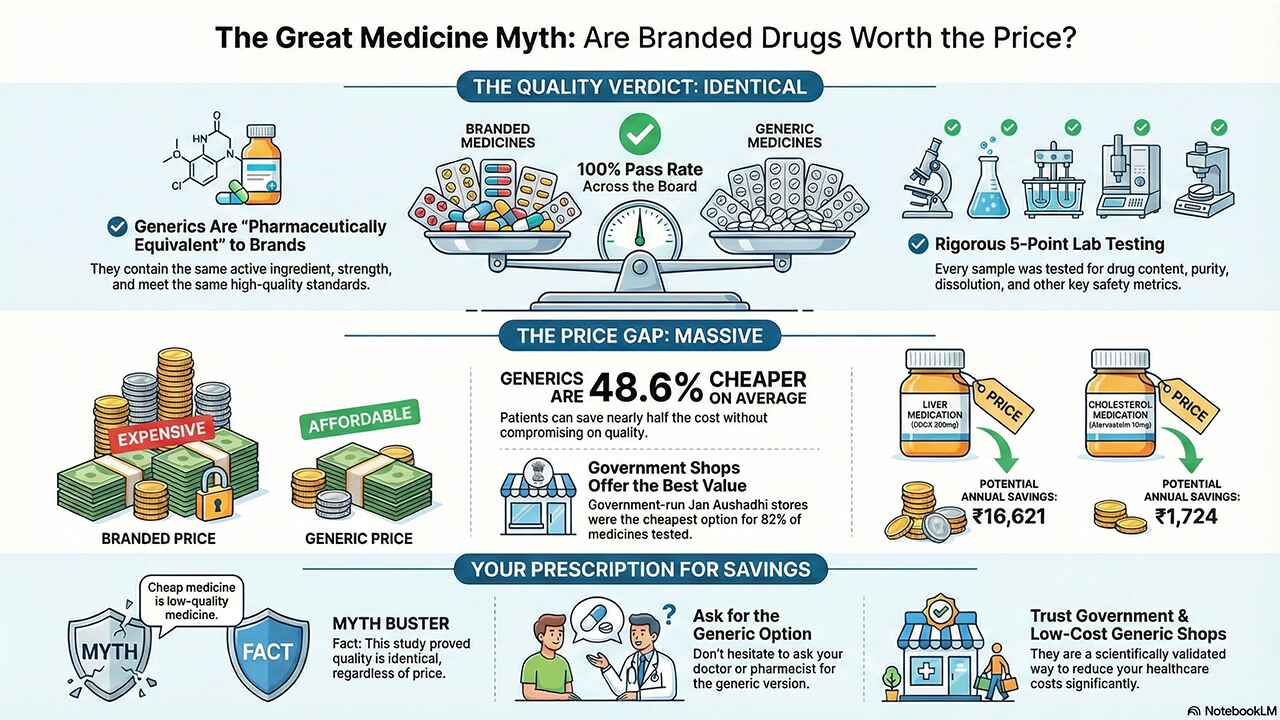
The Verdict: The study found zero difference in quality between expensive branded medicines and affordable generics. Every single sample tested met the strict quality standards required by law, regardless of the price tag.
How the Study Was Done
To ensure the results reflected real-world conditions, the researchers followed a strict process:
- What was tested? They collected 131 samples covering 22 different types of medicines. These included drugs for heart conditions, diabetes, infections (antibiotics), cholesterol, pain relief, and stomach issues. This study included 8 therapeutic categories. The therapeutic categories and the specific medications evaluated under them were:
- Analgesics/anti-inflammatory: Acetaminophen (Paracetamol), Ibuprofen, and Prednisolone.
- Antibiotics: Azithromycin, Amoxicillin, and Rifaximin.
- Gastrointestinal agents: Ranitidine, Pantoprazole, Omeprazole, and Ursodeoxycholic Acid (UDCA).
- Cardiovascular drugs: Atorvastatin, Amlodipine, Telmisartan, Clopidogrel, and Aspirin.
- Respiratory and anti-allergy medications: Montelukast and Cetirizine.
- Metabolic/endocrine agents: Metformin, Levothyroxine (Thyroxine Sodium), and Febuxostat.
- Nutritional supplements: Folic acid and Calcium with Vitamin D
- Where did they come from? Medicines were bought from 7 different types of sellers in Kerala, India, including:
- Government shops: Jan Aushadhi and Kerala Medical Services Corp (KMSCL).
- Private pharmacies: Chains like Dava India and Generic Aadhar.
- Standard medical shops: Buying both expensive “Branded” drugs and “Branded Generics”.
- How were they tested? The samples were sent to Eureka Analytical Services (a lab approved by the NABL and US-FDA). They tested the drugs against the Indian Pharmacopoeia 2022, the official book of standards for medicines in India. Additionally, quality of drug Febuxostat was checked using the Japanese Pharmacopeia and that of Rifaximin using the updated Indian Pharmacopeia 2024 guidelines.
Key Finding #1: Quality is Identical
The laboratory ran five specific tests on every pill, checking for things like:
- Drug Content: Does the pill actually contain the amount of medicine it claims? (e.g., Does a 500mg pill actually have 500mg?)
- Dissolution: Does the pill dissolve properly in the stomach so the body can absorb it?
- Purity: Are there any harmful impurities or bad chemical by-products?
The Results:
- 100% Pass Rate: All 131 samples passed every single test.
- No “Bad” Generics: There were no failures found in description, weight, purity, or drug content for any generic or government-supplied medicine.
- Equivalence: The study scientifically proved that the medicines from Jan Aushadhi and other generic shops are “pharmaceutically equivalent” to the expensive brands
THE QUALITY RESULTS IN DETAIL:
- • Assay (API Content): All samples fell within the required 90–110% range of the label claim. While branded medicines showed a slightly higher mean assay value (101.44%) compared to government generics (approx. 97.4–97.5%), the differences were within official acceptance limits.
- • Dissolution and Disintegration: These tests ensure the drug releases correctly in the body. Branded formulations showed the highest dissolution values (mean: 96.32%), but government generics (mean: 87.61%) and other generic sources also remained well above the minimum pharmacopeial thresholds.
- • Uniformity of Dosage: Both branded and generic products showed consistent manufacturing quality. Branded products exhibited slightly tighter quality control (1.75% mean deviation) compared to government generics (2.13%), but both were well within the safety limits of ±5.0% to ±7.5%.
- • Related Substances/Impurities: There was no evidence of excessive degradation or impurity contamination in any of the generic or branded samples, confirming that generic manufacturing quality is robust.
- • Physical Characteristics: All samples complied with their labelled descriptions and showed no visible defects like chipping or moisture damage
Key Finding #2: The Price Gap is Massive
While the quality was the same, the prices were drastically different.
- Generics are Cheaper: On average, generic medicines were 48.6% cheaper than branded versions.
- Government Shops Offer Best Value: The government-run Jan Aushadhi stores were the cheapest option for 81.8% of the medicines tested.
- Huge Markups: In some cases, the most expensive branded product cost nearly 14 times more than the lowest-priced generic for the exact same medicine.
Why “Lab Testing” is Enough: The Science of Equivalence
It is important to understand why the “pharmaceutical equivalence” proven in this study is the gold standard for checking medicines bought from pharmacies – anywhere in the world, including Indian regulatory standards. “Pharmaceutical equivalence” means the generic drug contains the exact same active ingredient, in the same strength, and passes the same rigorous quality tests as the branded version. Some critics argue that drugs need “bioequivalence” testing (trials on humans to measure drug levels in blood) to be proven effective. However, according to modern international medical guidelines (including the WHO and US-FDA), human testing is not necessary for the common, standard medicines tested in this project. Because these drugs dissolve rapidly and easily in the body, passing the strict laboratory dissolution tests is scientifically accepted proof that they will work just as well as the brand. Furthermore, all these medicines have already been approved by drug regulators in the past; therefore, checking their pharmaceutical quality in the lab is the correct and standard method for ensuring that the pills currently sitting on the shelf are safe and effective for patients.
The decision to omit these tests was based on several specific factors:
• Regulatory Biowaivers: Under internationally harmonized guidelines (ICH M9), in vivo bioequivalence studies can be waived for certain immediate-release drugs (Class I and III) if they demonstrate rapid or very rapid dissolution in laboratory settings. The majority of medicines in this study met these criteria.
• Existing Market Authorization: All products tested were already legally marketed in India, meaning they had already satisfied the necessary regulatory requirements, including initial bioequivalence documentation, at the time of their original approval.
• Purpose of the Study: The investigation was designed as post-market quality surveillance to ensure ongoing compliance with the Indian Pharmacopoeia 2022. For this purpose, in vitro (laboratory) pharmaceutical quality testing is considered both appropriate and sufficient by the World Health Organization (WHO).
• Resource Constraints: While the authors acknowledge that bioequivalence studies provide definitive evidence of therapeutic equivalence, they are significantly more resource-intensive to perform than the pharmaceutical quality tests conducted in this study.
In short, the study confirmed that the medicines were manufactured correctly to standard, which is a scientifically sound predictor of how they will perform in the body
The Power of “Mystery Shopping” and Rigorous Batch Testing
The “mystery shopping” method was critical to this study because it ensured that the medicines tested were exactly what everyday patients buy, rather than special “perfect” samples that manufacturers might send for inspection. By having trained staff purchase medicines anonymously from licensed retail outlets, the researchers captured the true reality of the market, avoiding any bias or cherry-picking. This method, combined with sourcing the same medicine from seven different types of sellers (from government Jan Aushadhi stores to private pharmacies), allowed for a fair, direct head-to-head comparison of products available to consumers. Furthermore, the study did not just test a single pill; it followed strict pharmacopeial standards that require testing multiple tablets from the same batch—such as individually weighing 20 units and analysing the chemical content of others—to ensure the entire strip was consistent. This rigorous approach proved that whether a patient buys a 40-rupee strip or a 400-rupee strip, the manufacturing consistency and quality remain identical.
Real-World Savings: What This Means for Your Wallet
The study calculated how much a patient could save by switching from the most expensive brand to the cheapest quality-tested generic (often Jan Aushadhi) for common treatments.
Examples of Potential Savings:
- Liver Medication (UDCA 300mg): You could save ₹16,621 per year by switching from the branded version (₹61.60/tab) to the Jan Aushadhi version (₹16.06/tab).
- Antibiotics (Rifaximin 400mg): For a single month of treatment, you save ₹2,502 by choosing the generic option.
- Cholesterol (Atorvastatin 10mg): You save 84% of the cost by using Jan Aushadhi (₹79 for 3 months) instead of a top brand (₹510 for 3 months).
- Supplements (Calcium + Vitamin D): You save 93% of the cost by choosing the government generic option.
Common Myths vs. Facts
Based on the scientific data from this study:
- MYTH: “Government medicines are low quality because they are cheap.”
- FACT: All Jan Aushadhi samples tested passed stringent quality control tests with 100% success.
- MYTH: “You need to buy big brands to ensure the medicine works.”
- FACT: Generic medicines contain the same active ingredients and dissolve in the body just as well as brands. You are often paying extra only for marketing and the brand name.
- MYTH: “Generics have more impurities.”
- FACT: No samples in this study showed evidence of excessive impurities or contamination.
Conclusion and Recommendation
This study challenges the misconception that “cheaper means worse.” The data confirms that quality-assured generics, specifically those from government schemes like Jan Aushadhi, are a scientifically validated way to reduce healthcare costs.
Actionable Advice for Patients:
- Ask for Generics: Don’t be afraid to ask your doctor or pharmacist for the generic version of a prescribed drug.
- Trust Government Outlets: Medicines from Jan Aushadhi Kendras or even private low-cost generic shops such as Dava India are quality-tested and can save you thousands of rupees annually.
Check Prices: Before buying a branded drug, check if a generic alternative is available. You do not need to compromise on quality to save money. Check attached link: “Details of All Drugs Tested”